For many Canadians who hold U.S. lawful permanent resident (LPR) status, often called a “green card”, it’s common to travel back and forth between Canada and the United States. But what happens if you plan to be outside the U.S. for an extended period? That’s when a re-entry permit becomes essential.
This article explains when you need one, why it matters, and how to apply, specifically from the perspective of Canadians who maintain strong ties to both countries.
What Is a Re-entry Permit?
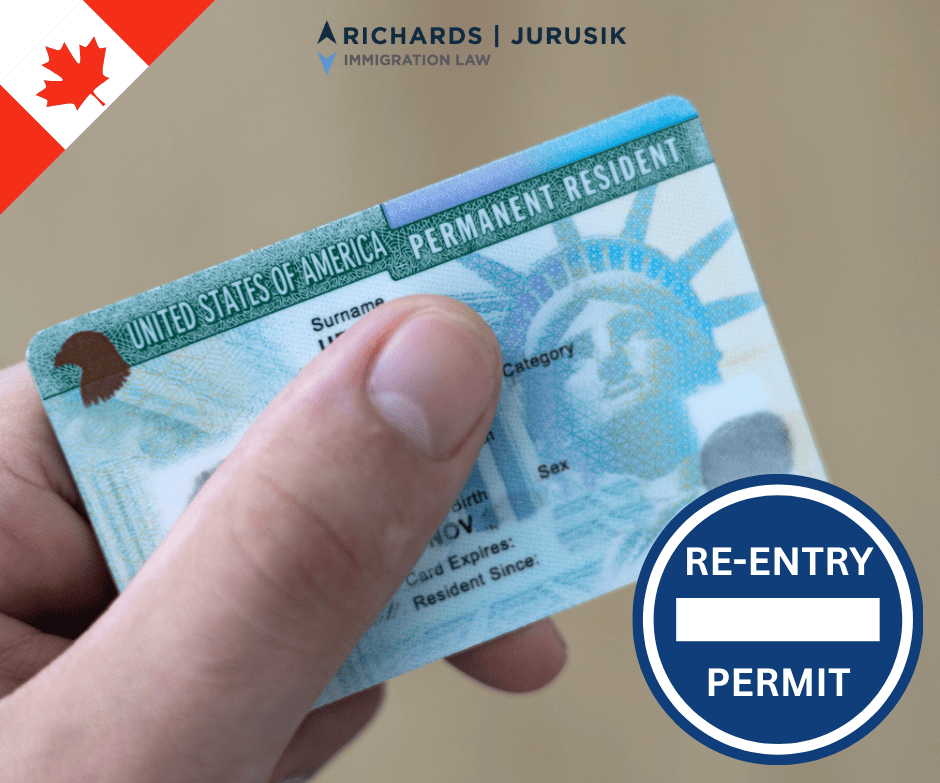
A re-entry permit (Form I-131, issued by U.S. Citizenship and Immigration Services or USCIS) allows a lawful permanent resident to remain outside the United States for up to two years without being considered to have abandoned their U.S. residency.
Essentially, it acts like a safeguard for your green card status when you need to spend significant time abroad.
Why a Re-entry Permit Matters for Canadians
Because of the proximity and close relationship between Canada and the United States, many Canadian LPRs assume they can come and go freely. However, U.S. immigration law doesn’t make exceptions for Canadians when it comes to maintaining residence.
U.S. permanent residency requires that your primary home, job, and life remain in the United States. If you spend too much time in Canada, even with good intentions, a border officer could determine that you’ve abandoned your LPR status.
A re-entry permit helps you show continued intent to live in the U.S. even if you need to spend time abroad for work, family, or other reasons.
When You Need a Re-entry Permit
You should apply for a re-entry permit before leaving the United States if you plan to:
- Stay outside the U.S. for one year or more. Any absence of 12 months or longer without a re-entry permit will likely result in being considered to have abandoned your green card.
- Travel frequently or for long periods. Even if each trip is less than a year, repeated or lengthy absences (for example, spending more than six months per year abroad) can raise questions about your intent to reside in the U.S.
- Maintain ties or property in Canada. Many Canadian LPRs keep homes, jobs, or family in Canada. A re-entry permit can help demonstrate that your long-term intention remains to live in the U.S.
- Work for a U.S. employer abroad. If you are temporarily assigned overseas, a re-entry permit confirms your U.S. residence during that period.
When You Might Not Need a Re-entry Permit
If your trips outside the United States are short (less than six months) and you maintain your home, job, and tax filings in the U.S., you likely do not need a re-entry permit. In such cases, you should still carry:
- Proof of your U.S. residence (such as a lease, mortgage, or utility bills);
- Evidence of employment or self-employment in the U.S.;
- Copies of your U.S. tax returns filed as a resident.
These documents help prove your continuing ties to the U.S. if a Customs and Border Protection (CBP) officer questions your intent at the border.
How to Apply for a Re-entry Permit
- File Form I-131 (Application for Travel Document) with USCIS while you are physically present in the U.S.
You must not leave the U.S. until you have attended your biometrics appointment (fingerprints and photo). - Attend your biometrics appointment.
Usually scheduled within 2–6 weeks after filing. - Request delivery abroad (optional).
You may request that the re-entry permit be sent to a U.S. embassy, consulate, or overseas address if you’ll leave the country after biometrics.
The permit is typically valid for two years and cannot be extended. If you need to remain abroad longer, you must return to the U.S. and apply for a new one before the current permit expires.
What Happens Without a Re-entry Permit
If you remain outside the U.S. for a year or longer without a valid re-entry permit:
- Your green card may be deemed abandoned;
- You might be denied entry at a U.S. port of entry;
- You may have to apply for a Returning Resident Visa (SB-1) through a U.S. consulate, a lengthy and uncertain process.
For Canadians, it’s particularly easy to fall into this situation unintentionally due to the convenience of crossing the border, so it’s best to plan ahead.
Key Takeaways for Canadians
- A green card requires residence and intent to live in the U.S.
- Time abroad, especially six months or longer, can trigger scrutiny.
- Apply for a re-entry permit before leaving the U.S. if you expect to be away for a year or longer, or if you travel frequently.
- Keep documentation of your U.S. residence, employment, and tax status at all times.
Final Thoughts
Being a Canadian with U.S. permanent residency offers great flexibility, but it also requires careful attention to travel and residency patterns. A re-entry permit is your best protection against losing your green card unintentionally.
If you’re unsure whether your travel plans could affect your residency status, consult an experienced U.S. immigration attorney familiar with cross-border Canadian cases before you go.
Schedule a Consultation with an Immigration Lawyer
Resources
We Can Help!
If you have questions regarding an immigration matter, we invite you to contact our team at Richards and Jurusik for detailed guidance and assistance. We aim to provide the most accurate and up-to-date information to make your immigration process smoother and less stressful. The immigration lawyers at Richards and Jurusik have decades of experience helping people to work and live in the United States. Please read some of our hundreds of 5-star client reviews! Contact us today to assess your legal situation.

JEREMY L. RICHARDS is the founding partner of Richards and Jurusik and has dedicated his career to U.S. immigration law, with a specialized focus on assisting Canadian and Mexican citizens under the United States-Mexico-Canada Agreement (USMCA) to work and live in the United States. (Full Bio)