The immigration lawyers at Richards and Jurusik Immigration Law have decades of combined experience in immigration law. We offer several consultation options, affordable flat fees, and excellent client service.
 Richards and Jurusik Immigration Lawyers
-
Thank you, Richard and the Jurusik team, for making the TN process smooth and seamless.
Special thanks to Rebecca Kroll for her knowledge, professionalism, and guidance throughout the entire process.
A truly knowledgeable team — highly … More recommended.


Canadian–U.S. Cross-Border Immigration Services
We assist individuals and businesses with immigration matters involving travel, work, and mobility between Canada and the United States, including:
- Canadian citizens seeking to live or work in the United States through TN visas, E-1/E-2 treaty visas, L-1 intracompany transfers, and permanent residence (green cards)
- Canadian entrepreneurs and investors expanding their businesses into the United States
- U.S. citizens who are having difficulty entering Canada due to criminal inadmissibility, including DUI-related issues
- Applications for Temporary Resident Permits (TRPs) and Criminal Rehabilitation for entry to Canada
- Immigrant and non-immigrant visa waiver applications
- Permanent residents seeking U.S. citizenship through naturalization
- Individuals facing removal or deportation proceedings in the United States
- Immigration applicants filing appeals with the Board of Immigration Appeals
- Mandamus petitions for delayed immigration applications and adjudications
Located in Buffalo, New York—one of the busiest border crossings between the United States and Canada—our firm has extensive experience assisting Canadian citizens, U.S. citizens, and cross-border businesses with immigration matters that arise between the two countries.
Our Latest US Immigration Video
Employment-based Immigration
Looking to Work or Do Business in the United States from Canada?
Canadian citizens and businesses often have unique opportunities to work and invest in the United States through visa classifications such as TN professionals, E-1 treaty traders, E-2 treaty investors, and L-1 intracompany transferees. We help Canadians understand their eligibility, navigate cross-border immigration options, and prepare strong applications so they can live, work, and grow their businesses in the United States.
Temporary Work Visas for Canadians
Canadian citizens have several options to work in the United States through temporary non-immigrant visa classifications. Many of these visa categories also allow spouses and children to accompany the principal applicant as dependents. Common options for Canadians seeking to work or conduct business in the United States include:
Employment-Based Green Cards
Some Canadian professionals and employees may qualify for permanent residence in the United States through employment-based green card categories. A U.S. permanent resident is authorized to live and work in the United States on a permanent basis and receives a permanent resident card, commonly known as a “green card.” Employment-based pathways to permanent residence may include:
- EB-1 Priority Workers (extraordinary ability, outstanding professors and researchers, and multinational executives)
- EB-2 Professionals with Advanced Degrees or Exceptional Ability
- EB-3 Skilled Workers and Professionals
- Other employment-based immigrant visa categories depending on the applicant’s qualifications
Immigration Business Plans for Cross-Border Businesses
For Canadian entrepreneurs, investors, and companies expanding into the United States, a well-prepared immigration business plan is often a key part of a successful visa application. With extensive experience handling E-1, E-2, and L-1 visa matters for Canadian businesses, we prepare immigration-compliant business plans in-house that are tailored to both your visa petition and your business model, including:
- Alignment with USCIS and U.S. immigration requirements
- Direct support for E-1, E-2, and L-1 visa petitions
- Clear documentation of investment, operations, and job creation
- Anticipation of common questions from immigration adjudicators
- Strengthening the credibility and overall presentation of your application
40+ Years Experience Leads to TN Visa Approval
Family-based Immigration
Family Immigration Between Canada and the United States
Canadian citizens and U.S. citizens are often separated by the border but may qualify for family-based immigration to live together in the United States. U.S. citizens and lawful permanent residents can sponsor certain qualifying family members—including Canadian spouses, children, and parents—for permanent residence (a green card). We help cross-border families navigate the immigration process so they can reunite and build their lives together in the United States.
Green Cards for Canadian Spouses
If you are a Canadian citizen married to a U.S. citizen, your spouse may be able to sponsor you for permanent residence in the United States. This process allows eligible Canadian spouses to obtain a green card and live and work in the United States on a permanent basis. We assist cross-border couples with preparing and filing the necessary petitions and applications to help make the transition to life in the United States as smooth as possible.
Green Cards for Canadian Family Members
If you are a Canadian citizen and the qualifying family member of a U.S. citizen or lawful permanent resident, your relative may be able to sponsor you for permanent residence in the United States. Eligible family relationships may include spouses, children, parents, and certain other relatives, depending on the sponsor’s immigration status. We help Canadian families navigate the sponsorship process and prepare the necessary petitions and applications to obtain U.S. permanent residence.
K-1 Visas for Canadian Fiancés
If you are a Canadian citizen engaged to a U.S. citizen, your fiancé may be able to petition for a K-1 fiancé visa on your behalf. The K-1 visa allows Canadian fiancé(e)s to enter the United States for the purpose of getting married within 90 days of arrival. After the marriage takes place, the Canadian spouse may apply for adjustment of status to become a lawful permanent resident (green card holder).
Guided Success from Permanent Residency to U.S. Citizenship
US Citizenship & Naturalization
U.S. Citizenship and Naturalization
Lawful permanent residents, including many Canadian citizens living in the United States, may be eligible to apply for U.S. citizenship through the naturalization process. We help permanent residents understand their eligibility, prepare their naturalization applications, and navigate each step of the process—including interview preparation and guidance through the final stages of becoming a U.S. citizen.
Do I qualify for US Citizenship?
Find out whether you meet the requirements to apply for US citizenship.
How do I apply for US citizenship?
Learn about USCIS Form N-400, which is used to apply for US citizenship through naturalization.
Can you help me apply for US citizenship?
Richards and Jurusik have extensive experience helping Canadians and other citizens apply for US citizenship.
Guided Success from Permanent Residency to U.S. Citizenship
Canadian Inadmissibility for US Citizens
Are you a US Citizen that has been refused entry to Canada? We can help.
If you are convicted of an offense, you may be inadmissible to Canada. This may be due to a criminal offense that you committed in the past such as a DUI, DWI, DWAI, OUI, DUAI, possession, assault, a felony, misdemeanor, fraud, or other convictions.
If you have been refused entry to Canada, were turned back at the border, or are unsure whether you are inadmissible, it is important to consult with a Canadian immigration attorney who can compare the law under which you were convicted with the equivalent law in Canada to see whether the conviction is one that makes you inadmissible. We can also determine whether your offense is one that is considered major or minor criminality.
Why was I denied entry to Canada?
There are different reasons why you may not be allowed to enter Canada, including security, medical, or criminal reasons.
How do I gain re-entry to Canada?
There are three ways to overcome your inadmissibility and get permission to travel to Canada again.
Can you help me gain re-entry to Canada?
Richards and Jurusik have extensive experience helping people who have been refused entry to Canada.
Overcoming Inadmissibility for Business Travel
Immigrant & Non-immigrant Visa (NIV) Waivers
Are you an immigrant or non-immigrant who has been found to be inadmissible to the United States? We can help.
There are times when persons are found to be inadmissible to the United States for previous criminal arrests, misrepresentation, or fraud (among other reasons). The immigration laws allow for waivers of those inadmissibilities for both immigrant and non-immigrant reasons.
For persons who may only be seeking to enter the United States for a temporary non-immigrant purpose, such as to visit, study, or work, their prior history may prevent them from being admitted into the United States. If you have been refused entry to the United States and have been found inadmissible, you might need a waiver.
Deportation & Removal Defense
Are you facing removal or deportation from the United States? We can help.
Removal defense (formerly called “deportation defense”) involves representing and advocating for immigrants facing removal or deportation from the United States.
For many immigrants, the process involves appearing before an immigration judge in immigration court. While most immigrants cannot afford to have an attorney represent them in court, legal representation is sadly the single most important factor in determining whether someone will win—or lose—their case.
Affirmative Asylum
Are you looking to apply for asylum in the United States? We can help.
Many people around the world have to flee their countries of birth due to being targeted because of their race, nationality, political opinion, or being a part of a particular group of people.
If you are in the United States, you can apply for protection in the form of an application for affirmative asylum.
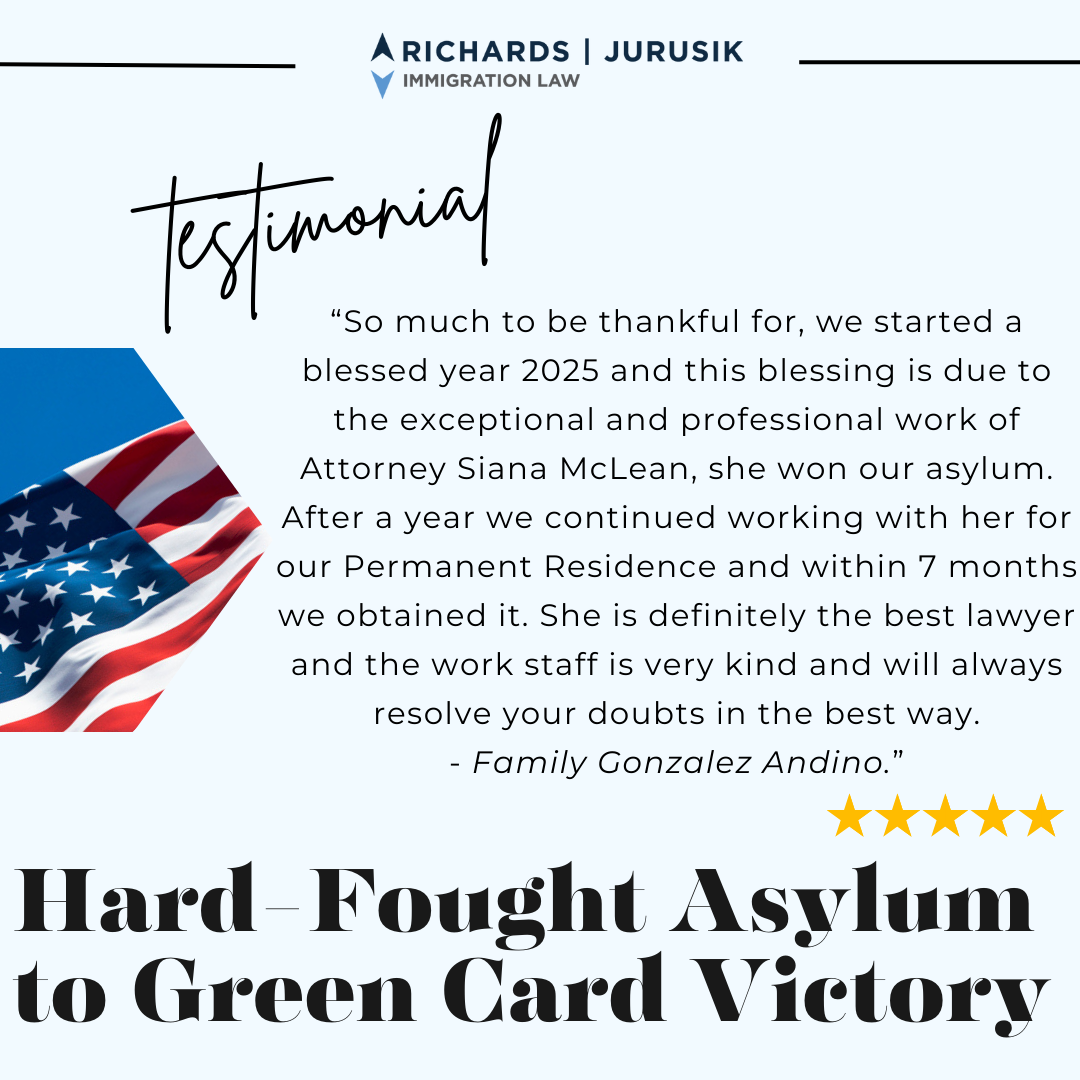
From Hard-Fought Asylum to Green Card Victory: A Journey of Hope and Success
Board of Immigration Appeals
Are you seeking assistance with your Board of Immigration Appeals case? We can help.
The Board of Immigration Appeals (BIA or Board) is the highest administrative body for interpreting and applying United States immigration laws.
In general, the BIA reviews appeals from certain decisions that Immigration Judges and district directors of the Department of Homeland Security (DHS) issue, ensuring that the immigration laws receive a fair and uniform application. Filing an appeal with the Board of Immigration Appeals (BIA) is a crucial step for many noncitizens facing removal because it is the last opportunity to obtain a favorable decision from the Executive Office for Immigration Review.
Immigration Delay Litigation
Has your immigration application been delayed? Do you need to file a Mandamus Petition? We can help.
The USCIS and the USDOS process millions of applications a year. While many applications move through the adjudication process smoothly and on time, some applications are delayed for any number of reasons. A Mandamus Petition may be necessary to keep things moving forward.
A Mandamus Petition is a lawsuit filed in U.S. District Court asking a federal judge for an order directing the government to perform a mandatory task. In immigration, this is an order directing USCIS and/or the State Department to make a decision about an immigration application that has been pending for an unreasonable period of time. An immigration lawyer may be able to resolve your case before filing a lawsuit, while in other cases they can file a lawsuit if the matter is not resolved.
Our Immigration Resources
The Arrive Podcast
With 1 to 2 new episodes each month, the Arrive Podcast can help you stay updated on the immigration law issues that matter the most to you.
Our US Immigration Videos
Richards and Jurusik Immigration Law regularly creates video content about the current state of a certain aspect of immigration law, and how it applies to Canadians living and working in the United States today.
Immigration Law FAQs
We are continually growing a comprehensive set of answers to frequently asked questions about immigration law. Find your answer, ask us a question, and sign up to stay updated.

H-1B Visa Stamping in 2026: Complete Guide to the Process, Documents, and DS-160

Can You Combine Education and Experience for a U.S. Work Visa?

Can You Reenter the U.S. With a Valid H-1B Visa and a New Employer?

Can You Start Working Before H-1B Approval? What the Rules Say in 2026